
Why We Rebuilt Our Chatbot to Be Smarter
We launched TEX with basic features because sometimes you need to go to market fast. But as a fast follow, we made him smarter and scalable. Here's the story of how we rebuilt his architecture by DRIVING AI to transform him from simple chatbot to intelligent assistant.
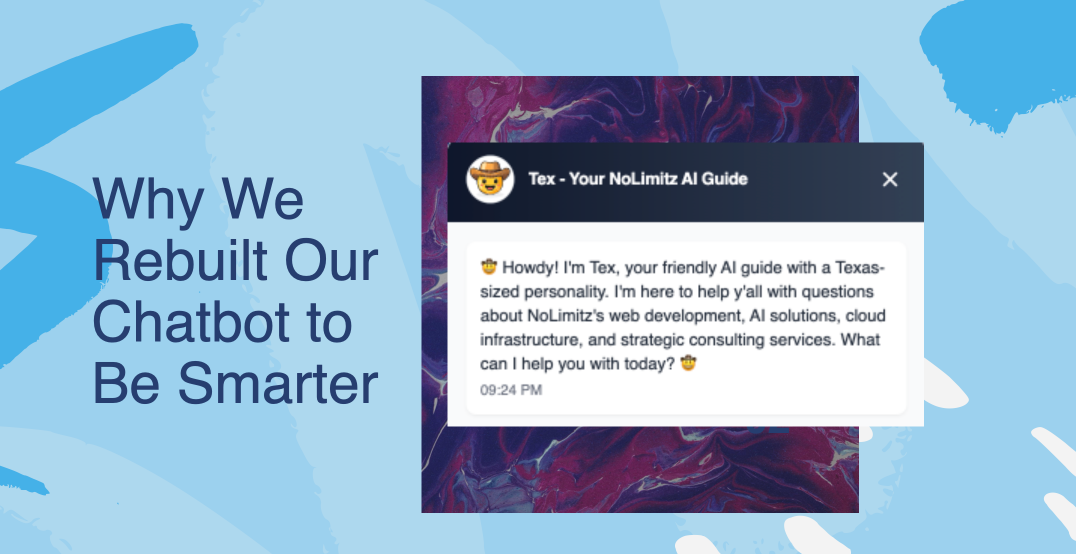
Meet TEX, my AI chatbot. He seems pretty smart when you talk to him, but here's a secret: he used to be a lot dumber. Here's the story of how I made him smarter by DRIVING AI architecture to rebuild how his "brain" works.
The Problem: My Chatbot Was Stuck in His Ways
When I first built TEX (my chatbot), I made a mistake that lots of people make when building AI systems. I hardcoded his personality and knowledge directly into the app's code.
Think of it like this: imagine if every time you wanted to teach someone something new, you had to perform brain surgery on them. That's basically what we were doing to TEX.
Every time I wanted TEX to:
- Learn a new way to respond to customers
- Get better at answering specific questions
- Adjust his personality to be more or less formal
- Test different approaches to see what worked better
I had to shut down the entire system, change the code, test everything, and redeploy. It was like rebuilding his brain every time I wanted him to learn something new.
Why This Was a Big Problem
Imagine you're running a business and your AI assistant says something that confuses customers. In the old system, fixing that would take hours or days. By then, you might have lost potential customers because your AI gave them a weird response.
The Solution: Give TEX a Removable Brain
I realized I needed to separate TEX's "brain" (his personality, knowledge, and instructions) from his "body" (the technical code that makes him work).
It's like the difference between:
- Old way: Having to rebuild a car every time you want to change the radio station
- New way: Being able to swap out the radio without touching the engine
I used two special tools to make this work: LangFuse (which manages TEX's personality and knowledge) and LiteLLM (which connects him to different AI "engines" like ChatGPT, Claude, and others).
How I Rebuilt TEX's Brain
Step 1: Moveable Personality
Instead of hardcoding TEX's personality into the app, I moved it to a separate system called LangFuse. Now TEX's instructions live in what I call a "prompt" that I can edit anytime without touching any code.
Think of it like writing instructions on a piece of paper that TEX reads every time he talks to someone. If I want to change how he acts, I just write new instructions. No brain surgery required.
Step 2: Multiple AI Engines
Here's something cool: TEX can now use different AI engines depending on what you're asking about. It's like having access to multiple experts.
- For creative questions: He might use Claude (great at creative thinking)
- For technical questions: He might use GPT-4 (excellent at explaining complex topics)
- For quick responses: He might use a faster, smaller AI model
If one AI system is having problems, TEX automatically switches to another one. You never notice, but TEX stays working even when individual AI services have issues.
The Cool Result: TEX Gets Smarter Every Day
Now I can improve TEX's responses in real-time. If I notice he's not helping people with a specific type of question, I can teach him better responses in minutes, not days. It's like DRIVING a learning assistant that actually learns and delivers exponential improvements.
Testing Different Versions of TEX
Here's one of the coolest parts: I can now run experiments with TEX's personality and see what delivers exponential results.
For example, I might test:
- Friendly TEX: More jokes, casual tone, longer conversations
- Professional TEX: Straight to business, formal tone, quick answers
I can show different versions to different visitors and see which one leads to more people contacting us or asking good questions. It's like DRIVING multiple AI personalities and optimizing for exponential engagement.
What This Means for Other Businesses
Most businesses that try to build AI assistants make the same mistake we initially made—they build systems that are hard to improve and adapt.
Here's what I learned that could help other businesses achieve exponential growth:
1. AI Should Be Easy to Improve
Your AI assistant should get better over time based on real conversations with real customers. If it takes weeks to make improvements, you're doing it wrong.
2. Have Backup Plans
Don't rely on just one AI system. If ChatGPT is down, your business shouldn't stop working. Build systems that can switch between different AI providers automatically.
3. Test Everything
Just because you think your AI should respond a certain way doesn't mean that's what works best for your customers. Build systems that let you test different approaches and measure what actually works.
Real Results from Our Rebuild
- Minutes to Update TEX - Down from hours or days
- 99.9% Uptime - Thanks to multiple AI providers
- 4 AI Systems Available - Automatic failover
- 150ms Response Time - Lightning fast responses
The Bigger Picture: DRIVING AI That Actually Helps
The real lesson here isn't about the technical details—it's about DRIVING AI systems that can actually adapt and improve based on real-world use to deliver exponential results.
Too many businesses build AI systems once and then never improve them. That's like hiring an employee and never letting them learn or get better at their job.
The future belongs to businesses that DRIVE AI systems designed to get smarter over time. Not just because the AI technology improves, but because the systems are built to learn from every customer interaction and deliver exponential improvements.
Want to Try Talking to TEX?
The chatbot you can talk to on this website is the result of everything we just described. He's not perfect, but he's always getting better based on conversations like the one you might have with him.
Every time someone talks to TEX, I learn something new about what works and what doesn't. That information helps me make him smarter for the next person.
Thinking About AI for Your Business?
The key is DRIVING systems that can evolve and improve, not just systems that work once. I help businesses create AI assistants that get smarter over time and deliver exponential growth instead of staying stuck with their original programming.
Want to Build Smarter AI for Your Business?
Let's talk about building AI systems that actually get better over time. No technical jargon—just practical solutions that work.
Start a Conversation or try talking to TEX to see him in action.
Ready to Transform Your Business?
Let's talk about how AI can help you achieve exponential growth.